
Reviewed · WALKING TOURS
Best of Buenos Aires Private Walking Tour
Buenos Aires has a talent for mixing grand architecture with very human stories, and this private walking tour is built for that. You’ll move through downtown landmarks tied to big money, big politics, and British and French influences, then finish with Recoleta and its cemetery, where history feels personal.
I like two things a lot. First, the route is packed with photo-stop architecture like Edificio Kavanagh and the French-style facades of Barrio Norte. Second, you get a real guided cemetery visit, not just a quick glance from the gate.
The one potential drawback is simple: this is solid walking. It runs in rain or shine, and the full time at each stop can shift a bit depending on weather and street conditions.
Quick hits before you go
- Meet right in the action at the Buenos Aires Walking Tours spot near Paraguay Street, with a clear start time.
- Calle Florida to Plaza San Martín in one smooth downtown thread, with stories that explain why the city looks the way it does.
- Kavanagh and the French imports angle, with details like UNESCO status and construction speed.
- British legacy with context, including Torre Monumental and the Malvinas remembrance right nearby.
- Recoleta with actual time, including Basilica de Nuestra Señora del Pilar and the expanded cemetery circuit.
- Private group pace, often praised as not rushed, with guides like Mariano, Martin, and Carlos mentioned for strong English and storytelling.
Price, time, and what value really looks like
This is priced at $109 per person for an experience that runs about 3 hours (listed as approx.), and it’s commonly booked around 59 days in advance. That timing tells you something useful: this isn’t the kind of tour that sits around unsold. It’s popular because it hits a lot of big sights without feeling like a checklist.
The value comes from three choices the operator makes. You get a professional English-speaking guide, you’re walking a dense cluster of neighborhoods, and the price includes the Recoleta Cemetery admission ticket. Meals are not included, so you’ll want water and a plan for a snack either after the tour or during a café stop later around La Biela.
Also, this is a private tour, meaning it’s only your group. That matters in Buenos Aires, where the best walking experiences usually depend on pacing, asking follow-up questions, and getting context that fits your interests.
More Walking Tours in Buenos Aires
- Buenos Aires Hop-On Hop-Off Bus, Free Walking Tours & Discounts
★ 4.5 · 2,218 reviews - Buenos Aires: La Boca Guided Walking Tour in English
★ 4.8 · 1,587 reviews - La Boca Walking Tour
★ 5.0 · 1,029 reviews
Who this tour suits best, and who should plan differently
If you like cities where architecture tells a story, you’ll be in the right place. This tour is a strong match for first-timers who want structure, plus returning visitors who enjoy facts, names, and “how did that get there?” details.
You’ll also enjoy it if you like history but not the dry kind. In the stops around downtown and Recoleta, the guide ties buildings to people and events, including British influence and the Malvinas/Falklands conflict, plus major local moments tied to embassies.
If you have mobility limits, or you hate long stretches on sidewalks, this is the part to think about. The itinerary is built for walking, and there’s rain-or-shine operation. Comfortable shoes are not optional.
Starting point at 10am: how to avoid missing your guide
You meet with Buenos Aires Walking Tours at Florida Garden, Florida 899, at the café corner door (the corner with Paraguay Street). Your guide holds a small BA Walking Tours sign. The instruction is very specific: you start no later than 10am, so I’d treat that as a hard deadline, not a suggestion.
The good news is the meeting area is in the central zone, so public transport should be convenient. There’s no hotel pickup, so plan to arrive under your own steam, then settle into an easy briefing right where the walking begins.
If you want a smoother start, arrive a few minutes early, then check that your group matches the sign. That small bit of attention saves you from the first 10 minutes of stress.
The first stretch: Calle Florida, early Buenos Aires, and a quick taste of the city’s pulse
The tour kicks off with Calle Florida, one of the oldest downtown streets, described as the connector between Plaza de Mayo and Plaza San Martín. This isn’t just a shopping street on a map. As you walk, you’re learning what the street has meant as Buenos Aires grew, which helps you “read” the city later when you wander on your own.
One reason this works is that Florida Street gives you a bridge. You transition from the government-squares feel toward the grand civic and cultural vibe near San Martín, without changing your route or your thinking. It’s a natural first lesson in how Buenos Aires layout shapes daily life.
A different sort of day out of Buenos Aires:
- Local Foodie Adventure in Buenos Aires with Sherpa Food Tours
★ 5.0 · 6,875 reviews - Buenos Aires City Private Tour with Local Guide
★ 5.0 · 3,475 reviews - Buenos Aires Small-Group City Tour
★ 5.0 · 2,226 reviews - Buenos Aires: Piazzolla Tango Show with Optional Dinner
★ 4.4 · 2,122 reviews
Basilica del Santisimo Sacramento: Lady Mercedes Anchorena’s 1916 masterpiece
Soon you’re at the Basilica del Santisimo Sacramento, built by Lady Mercedes Anchorena for her family in 1916. The key value here is that you’re seeing a religious building with the context of private wealth and local power networks. That blend, family story plus architectural impact, is exactly what turns a photo stop into a memory.
The tour frames the basilica as astonishingly beautiful and tied to stories that feel almost like high-drama gossip. I like this kind of stop because it teaches you how Buenos Aires history often lives in personal relationships, not just big dates.
Admission here is free to see from the outside on the route. If you want to spend extra time, keep your pace and save it for after the guided portion, since the tour keeps moving.
Edificio Kavanagh: the Art Deco skyscraper with UNESCO-grade credibility
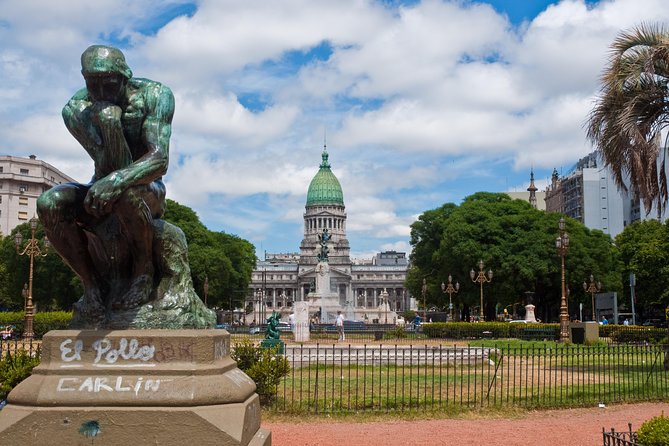
Next is Edificio Kavanagh, the tallest Art Deco skyscraper in Buenos Aires. The standout details are very specific: it overlooks Plaza San Martín, it’s a UNESCO heritage building, and it was commissioned in 1934 by Corina Kavanagh, who sold two ranches at age 39 to make her landmark tower happen.
The construction story is part of the appeal, too. It took only 14 months, which is one of those facts that makes you look twice at the skyline and realize how fast big ambition can move when money, design, and politics align.
This is also where the guide’s delivery matters. Multiple guides connected to this experience have been praised for storytelling and strong English, including Mariano and Martin, so you’re likely to get both the design facts and the human angle behind the building.
Torre Monumental and Malvinas/Falklands remembrance: British legacy with hard context
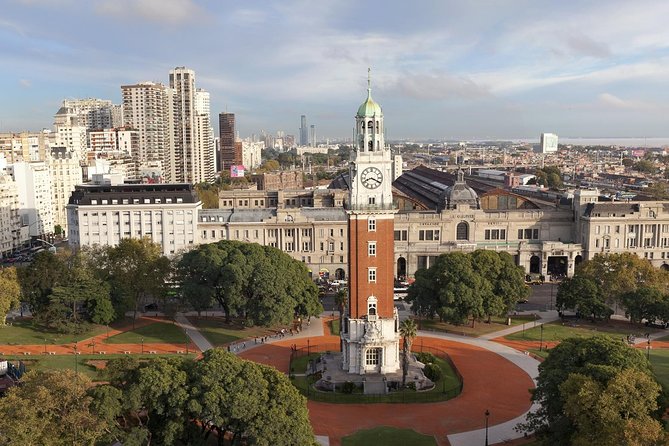
Then you pivot to Torre Monumental, a British clock tower now known under that name, with a memorial just opposite related to the 1982 South Atlantic war (Malvinas/Falklands). You also stop at the Monumento a Combatientes de Malvinas, which the tour uses to explain Argentina’s long-standing love and hate relationship with England.
This section is valuable because it doesn’t treat the British influence as a cute design detail. It ties the architecture and the clock tower to real national trauma and ongoing debate. You end up with a more complete picture of why you see British-named buildings, British economic influence, and also why that history can feel complicated.
If you prefer history presented in a straightforward way, this portion should work well. It’s not just dates. It’s context, proximity, and meaning.
Plaza General San Martín: a park that has held slavery-era echoes, a fort, and a bullring
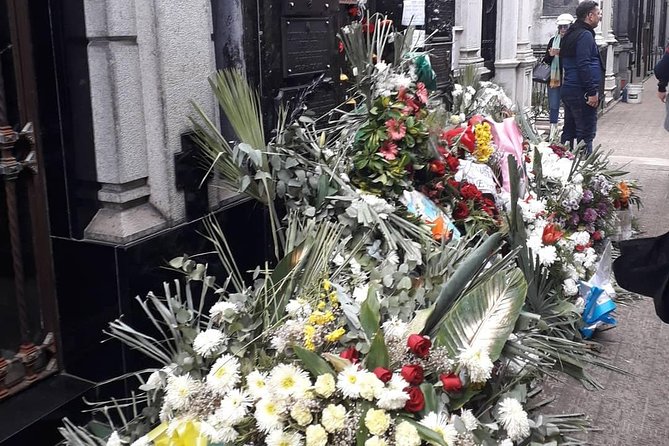
At Plaza General San Martín, you’re told the park area held a fort, a bullfight ring, and old slave depots nearby. Today it centers on a massive monument to Gral. Jose de San Martín, and the guide shares his full story.
I like this stop because it shows how Buenos Aires can layer uses over time in a small space. You’re not looking at a single-era monument. You’re watching a city repurpose ground over generations, which helps you understand why neighborhoods feel both elegant and haunted at the same time.
Palacio Paz and Palacio San Martín: French materials, imported ambition, and the Anchorena touch
The tour next moves into palaces that explain why Buenos Aires earned its Paris-of-the-South reputation.
At Palacio Paz, built in 1914 for José C. Paz, you’re told he was the proprietor of the city’s then-second most-circulated newspaper and an aspiring President. The building’s style is tied directly to France: it was built with materials imported from France, and it’s described as having 120 rooms for a family of four.
Then comes Palacio San Martín, described as the Anchorena Family Palace, later called San Martín for political reasons. The guide focuses on Mercedes Anchorena again, emphasizing the family’s role in shaping local landmark architecture, plus the nearby church built for the family.
If you like architectural storytelling, this is one of the strongest stretches of the day because you get both design and social motivation. These stops help you understand that Buenos Aires wealth and identity were imported, engineered, and broadcast through buildings.
Barrio Norte’s elegance: Palacio Estrugamou, embassies, and Paris-style streets
Now you enter Barrio Norte through a cluster of stops that connect elegance to immigration and international ties.
At Palacio Estrugamou, you’re given a street-level orientation to why Barrio Norte earns its “Paris of the South” nickname. The tour frames the neighborhood with Paris-style mansions and explains immigration patterns across Spanish, Italians, French, and British communities.
Then you hit two embassies and related political stories. At Plaza Israeli Embassy, there’s a 1992 bombing that destroyed the local Israeli embassy, killing 24 people. The guide explains the why, how, and who, then connects it to broader politics and justice in Argentina. This is not a casual stop. It’s heavy, and the value is in being guided through the facts without turning the memorial into a spectacle.
At Embajada de Francia, the building is originally the Ortiz-Basualdo Palace. One of the specific stories mentioned is when Edward VII of England came to visit with his American wife-to-be. Even if you only remember one detail from this leg, it’s a good one, because it shows how Buenos Aires attracted global attention through its elite circles.
Next is Embajada de La Santa Sede Nunciatura Apostolica, and this is where you get social and religious connections in plain language. The tour asks why Argentina has a Pope, how ultra-rich women linked to families like Anchorena, Harilaos, and Alvear relate to the church, and why Adelia Harilaos donated her palace to the Vatican. You also see gardens connected to the property.
This section works best if you enjoy cause-and-effect thinking: architecture leads to wealth, wealth leads to influence, influence leads to relationships that last for generations.
Patio Bullrich: from cattle auctions to a posh mall
At Shopping Patio Bullrich, the tour gives a classic Buenos Aires twist. This “poshest mall” has a very practical origin. The site began as a British horse-and-cattle auction building, built in 1867 for the Bullrich family. Later, it became a sales and consignment place for valuable heirlooms and prized livestock, designed by English Argentine architect Juan Waldorp.
What I like here is the reversal. You’re used to seeing British influence as something abstract. This stop makes it physical, right down to what the building was used for. It’s also a useful lesson for walking in Buenos Aires on your own, because you start noticing how many glamorous places began as something industrial or commercial.
This is listed as a longer stop (about 15 minutes), which makes sense since it’s a place you might want to look around before you move on.
Recoleta and Barrio Norte: why this area feels like a postcard, and why it’s more than that
The tour lands in Recoleta, described as affluent, strollable, and known for Paris-style townhouses, former palaces, and posh boutiques. The background detail matters: Recoleta land was given to Recoletos Franciscan Monks as a gift.
This is the part of the tour where the mood changes. The stories are still there, but the streets feel quieter and more composed. It’s a good time to pace yourself, because the day is about to ask for serious attention at the cemetery.
Avenida Alvear: the elegant mansions and the immigration story behind them
On Avenida Alvear, you stroll alongside lavish mansions and you get a summary of immigration between 1880 and 1930, plus the rise and fall of Argentina in that era. This isn’t presented as a generic “people came here” speech. It’s tied back to the buildings you saw earlier, especially the European style and the families behind it.
If you want to take photos without rushing, this is a good spot to slow down for a few shots. The buildings are grand, but the street itself gives you enough space to enjoy the walk.
Basilica de Nuestra Señora del Pilar: colonial Recoleta and the monastery connection
At the Basilica de Nuestra Señora del Pilar, you’re told it’s colonial and was completed in 1732 as part of the Franciscan Recoletos monastery. It’s described as the second-oldest church in Buenos Aires.
The value here is timing. You’ve just been learning about the modern city’s international ambitions. Now you’re stepping back into the early colonial era, with religious architecture that predates many of the wealth-era buildings around it.
The stop includes admission on the schedule and is listed around 10 minutes, so it’s a chance to absorb the scale without draining the day before the cemetery.
Recoleta Cemetery: the stop that needs attention, and why the guide matters
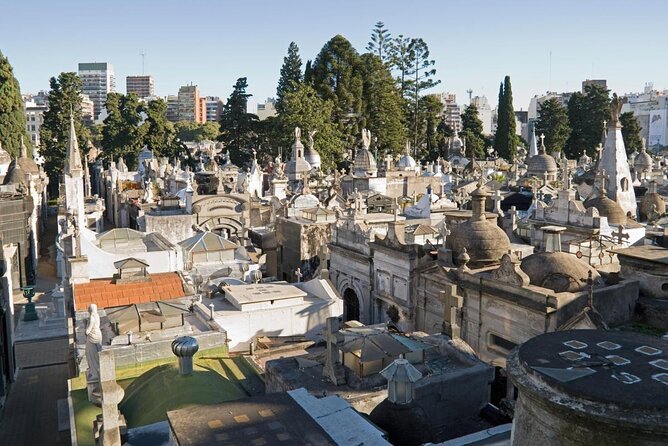
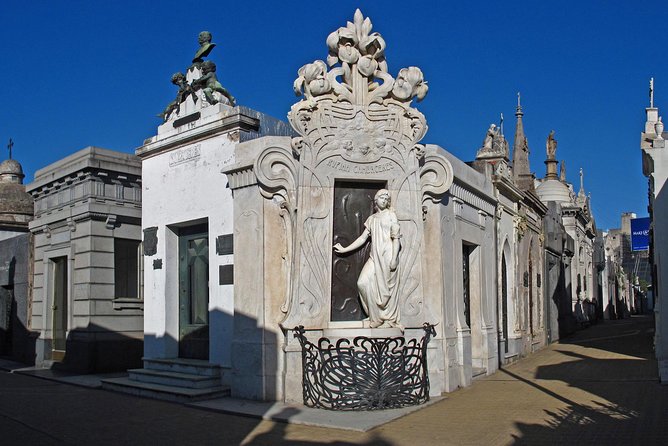
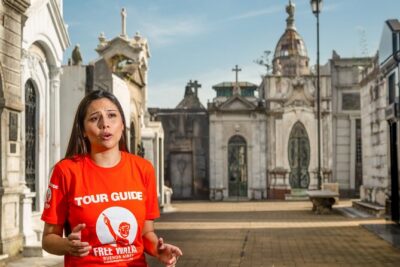
This is the big ending component: La Recoleta Cemetery, with a detailed visit listed for about 1 hour, and cemetery admission included.
This is where the tour’s approach makes a real difference. Instead of only pointing out a famous name, the tour plan includes multiple people and sites, including Evita Peron’s memorial and story, plus other figures like Rufina Cambaceres and Tiburcia Dominguez, and a range of named individuals such as Admiral Brown, the ultra-rich Leloir, and General Guido and Liliana Crociatti.
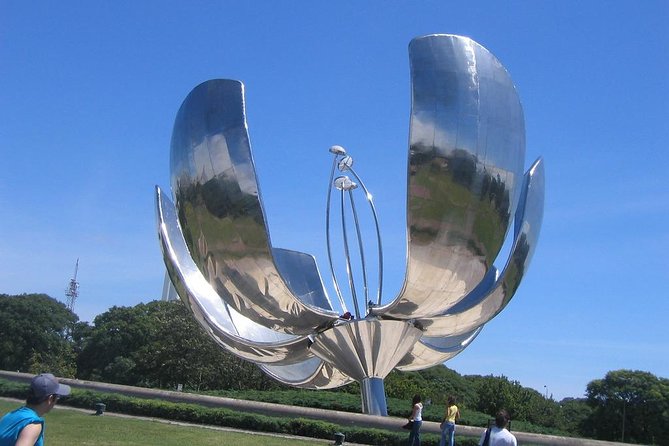
The itinerary also includes a set of cemetery-adjacent stops and cultural points, like Bourdelle’s monument to Alvear, the Palais de Glace where tango became of age, and the National Library and Loma Mitre quadrant areas. You also get a story thread connecting tango, ports, and immigration, plus visits to places like the National Fine Arts Museum and terraces, and even a giant flower close-up when available.
A practical note: this portion is long and information-heavy. It’s easy to stand in one area for a photo and lose the flow, so stay with your guide and accept that you’ll need a second pass later if you want total independent wandering.
La Biela: where you finish and what you can do next
The tour ends just outside La Biela café on Av. Pres. Manuel Quintana 596. The guide uses this as a launch point to explain the neighborhood and nearby attractions, so you can choose what fits your interests once you’re free to roam.
La Biela is also a practical choice because it’s easy to orient from. You’re finishing in an area that’s meant for walking, café time, and browsing, without having to immediately navigate back through dense downtown streets.
A note on pace, itinerary changes, and one common snag
Two things can affect how the day feels. First is walking volume. Even when the pace is described as not overly arduous, it’s still a full stretch of city blocks. Second is time and conditions. The tour notes that the full itinerary may depend on weather, city dynamics, and timing.
One review-style lesson you should take seriously: in some cases, the cemetery portion or parts of the day may not match the strictest version if time runs short. That doesn’t mean it’s a bad tour, just that you should ask your guide how they’ll prioritize if the day gets delayed.
Also, one caution from the feedback style you can keep in mind: sometimes guides can mention other tours. If you want zero sales energy, be direct, ask your question, and steer back to the story at hand.
Guides and what to expect from the way they teach it
This experience leans hard on storytelling, and the strongest comments connect it to specific guides. Mariano is mentioned for being very knowledgeable and showing parts of the city you might miss on your own. Martin appears in praise for impeccable English and making it funny and memorable. Carlos is described as droll and informative about architecture in Recoleta.
So your expectation should be this: you’re not just seeing buildings. You’re getting explanations that help those buildings make sense in a wider Buenos Aires story.
Should you book this Best of Buenos Aires private walking tour?
Book it if you want a high-density route that mixes architecture, political context, and neighborhood texture, without needing to research each stop in advance. I especially think it’s a strong value if the included cemetery ticket matters to you and you want a guided visit that covers more than one famous grave.
Consider a different plan if you hate long walks, if you’re arriving late and can’t make the 10am start, or if you need very predictable timing at the cemetery regardless of conditions. This tour does run in rain or shine, and street realities can shift minutes around.
If you do book, wear good shoes, bring water, and keep your camera ready for the skyline moments at Kavanagh and the mansion-lined streets of Barrio Norte. This is one of those experiences where the city starts feeling like a story you can actually follow.
FAQ
How long is the walking tour?
It’s listed at about 3 hours, with the walking tour described as around 2.5 hours.
Is this tour private?
Yes. It is a private tour, so only your group participates.
What language is the guide?
The tour includes a professional English-speaking guide.
What is included in the price?
The tour includes the professional guide and a Recoleta Cemetery admission ticket. Meals are not included.
Where do we meet?
You meet at Buenos Aires Walking Tours at Florida Garden, Florida 899, outside the café corner door on the corner with Paraguay Street.
What time does it start?
You meet and start the tour no later than 10am.
Does the tour run in bad weather?
Yes. It operates rain or shine.
Recently reviewed around Buenos Aires
- Meet Locals: Language Exchange Café in Buenos Aires★ 5.0 · 10 reviews
- Madero Tango Show Including Executive Dinner In Buenos Aires★ 3.5 · 10 reviews
- Piazzolla Tango Show Only In Buenos Aires★ 4.5 · 10 reviews
- Esquina Homero Manzi Tango Show Ticket Including Optional Dinner in Buenos Aires★ 4.5 · 10 reviews
- Private City Tour & Transfer to the International Airport★ 5.0 · 10 reviews
- VIP Dinner & Tango Show at El Viejo Almacen★ 4.5 · 10 reviews
- Buenos Aires City Tour★ 4.5 · 11 reviews
- Premium service Buenos Aires city tour for small groups★ 4.0 · 11 reviews
Walking Tours, compared.
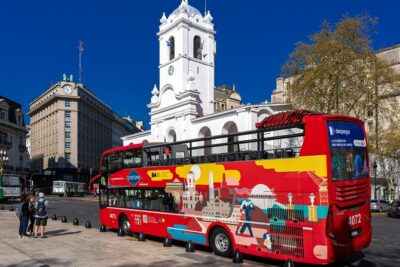
Buenos Aires Hop-On Hop-Off Bus, Free Walking Tours & Discounts
Read our review →
German Footprint & Nazi presence – Walking Tour in Bariloche
Read our review →
Full Day Buenos Aires Private Walking Tour – Your Own Personal BA 101
Read our review →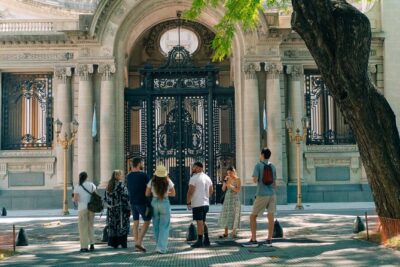
Discover Buenos Aires: Walking Tour Through San Telmo & Center!
Read our review →
Browse the lists this tour appears in