Reviewed · PRIVATE
Private Architecture and Palaces Tour in Buenos Aires
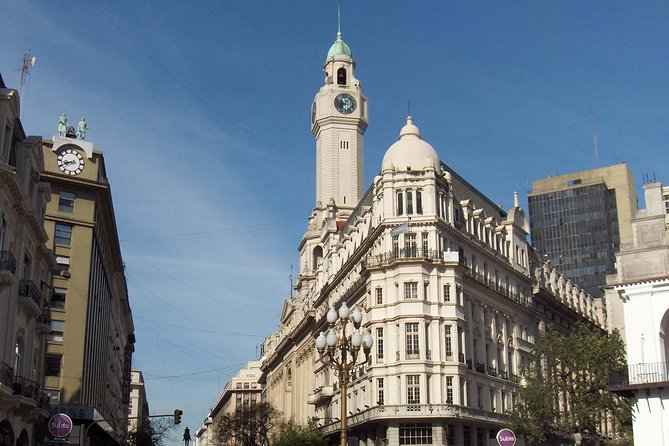
Buenos Aires architecture has a knack for telling stories with stone, ceramic, and a whole lot of ambition. I like that this tour is private and feels personal, and I also like the free hotel pickup that makes the day easy from the start.
You get a tight route through major landmarks, with a guide who can explain what you are looking at without turning it into a lecture. In past groups, guides such as Alexandra, Julieta, Carolina, and Mariella have stood out for making the information clear, friendly, and easy to connect to the neighborhoods you are passing through.
One caution: the stops are short (about 10 minutes each), so this is best for getting your bearings and catching details fast, not for spending lots of time going deep inside every site. Also, Teatro Colón admission isn’t included, so plan for that if you want to visit.
Key highlights you will actually feel during the tour
- Free hotel pickup and drop-off so you can focus on the buildings, not logistics
- Small group, private feel, with time to step out for photos and quick walks
- Dante-inspired design at Palacio Barolo, plus an extra layer of pop culture trivia
- A fast, smart route through Monserrat, Retiro, Recoleta, and the city center
- Art Nouveau arcade in Galería Güemes, one of the most characterful pedestrian passages in town
- El Ateneo Grand Splendid, a theater reborn as one of the world’s most memorable bookstores
Why Buenos Aires architecture feels like a living conversation
This tour is interesting because it links style to time and to people. You do not just see buildings, you learn what Buenos Aires was chasing when it built them: status, modern engineering, European taste, and local identity all at the same time.
You will also notice something important. Buenos Aires is not one look. It is a stack of eras sitting next to each other, from civic grandeur to private residences to cultural landmarks turned into public spaces.
And the format helps. A 3-hour window is long enough to make sense of a neighborhood cluster, but short enough that you can still enjoy a normal day afterward for lunch or additional sights.
A few more Buenos Aires days worth comparing
- Local Foodie Adventure in Buenos Aires with Sherpa Food Tours
★ 5.0 · 6,875 reviews - Buenos Aires City Private Tour with Local Guide
★ 5.0 · 3,475 reviews - Buenos Aires Small-Group City Tour
★ 5.0 · 2,226 reviews
Price and what $140 per person covers (and what it doesn’t)
At $140 per person for about 3 hours, the real value is that you get more than a guide talking from a sidewalk. You are paying for:
- A guided route that connects the dots between the buildings
- Hotel pickup and drop-off, which saves time and reduces stress
- A pace that lets you step out, look closely, and still stay on schedule
What is not included is food and drinks. Entrance fees are also not fully included. Most stops are free, but Teatro Colón has an admission fee not included in the tour price.
That matters because it lets you budget realistically. If you want to treat Teatro Colón as a must-see interior, plan extra time and money. If you are fine with an exterior stop and photo viewing, this tour stays straightforward.
The ride between stops: easy transport, not a long bus day
You will be moved by vehicle between locations, which is a win in Buenos Aires traffic. The rhythm is also practical: short steps out for photos and quick orientation, then back into the vehicle to reach the next landmark before the day slips away.
Several past groups noted that the setup feels seamless, with a driver that makes transitions easy. You get the benefit of being downtown quickly, without feeling stuck in a slow or complicated plan.
Stop 1: Palacio Barolo in Monserrat and its Dante-meets-technology vibe
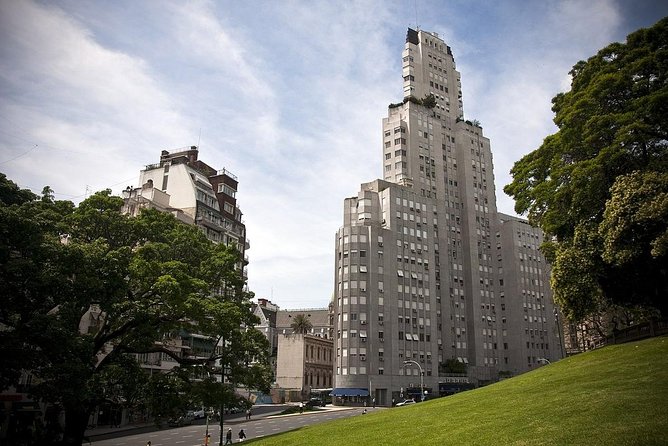
Palacio Barolo is the kind of building that makes you look twice, then look again. It was designed by the Italian architect Mario Palanti for businessman Luigi Barolo, in the Monserrat neighborhood. One of the big takeaways is how ambitious the project was for its era, including the claim that it was the tallest building in South America until the Kavanagh was built in 1935.
Here are the details that make this stop feel special:
- It was the first reinforced concrete building of nearly 100 meters tall
- The top features a revolving headlight described as using 300,000 spark plugs, with a real-world connection to the boxing title fight between Luis Ángel Firpo and Jack Dempsey in New York (as the story goes, the light transmission carried the fight results)
- The building incorporates references to Dante Alighieri’s Divine Comedy, organized into three parts that correspond to hell, purgatory, and heaven
- You also get a design influence that reaches beyond Europe, with references to the Palace of the Winds in Jaipur and the Rajarani temple in Bhubaneswar
The practical part: you can admire a lot of this from the outside while still getting the symbolism explained. If you like architecture that mixes engineering, literature, and showmanship, this stop alone can justify the tour.
A different sort of day out of Buenos Aires:
- Buenos Aires Hop-On Hop-Off Bus, Free Walking Tours & Discounts
★ 4.5 · 2,218 reviews - Buenos Aires: Piazzolla Tango Show with Optional Dinner
★ 4.4 · 2,122 reviews - Buenos Aires: City Highlights Guided Tour with Transfer
★ 4.7 · 1,946 reviews - Buenos Aires: Hop-On Hop-Off City Bus Tour
★ 4.2 · 1,855 reviews
Congreso de la Nación Argentina: civic power in neo-classical form
Next up is the Palace of the Congress of the Argentine Nation, a neo-classical building that sits on a large block area of about 12,079.6 m². It is one of the biggest congress complexes in the world, and its scale shows in how it anchors the surrounding city grid.
This is a good stop to understand how Buenos Aires used architecture to project confidence. Even if you are not a politics fan, the building teaches you something about the era’s mindset: formality, symmetry, and a sense that government should look monumental.
Also, because this stop is free, it is a low-risk part of the route. You can enjoy the exterior focus without worrying about budget surprises.
Teatro Colón nearby: how to handle the ticket and still enjoy the area
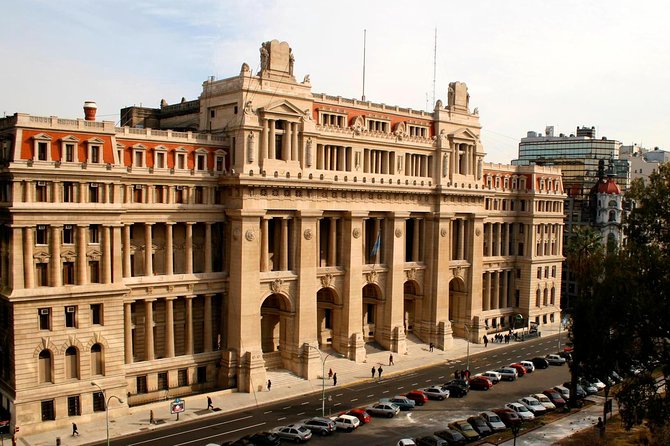
The tour includes Teatro Colón, widely considered one of the best theaters in the world for acoustics and artistic construction. The current building’s timeline is part of the fascination: the foundation stone was laid on May 25, 1890, with the goal of opening before October 12, 1892, and the theater was ultimately inaugurated in 1908 with Verdi’s Aida.
The style is eclectic and early twentieth-century. In plain terms: it is a statement of ambition, built over a long period (about 20 years for the new building).
Two practical notes for you:
- Admission isn’t included, so if you want interior access, you need to plan for that separately.
- Because the stop is short, you should treat this as either a photo and orientation moment, or a timed connection to a visit you arrange.
If you are already planning a theater day in Buenos Aires, this stop helps you place Teatro Colón in context without eating your whole schedule.
Palacio de Aguas Corrientes, Palacio Paz, and Palacio San Martín: Buenos Aires goes dramatic
This stretch is where the tour’s theme becomes obvious: Buenos Aires loved grand statements. You will see three big players that show that taste.
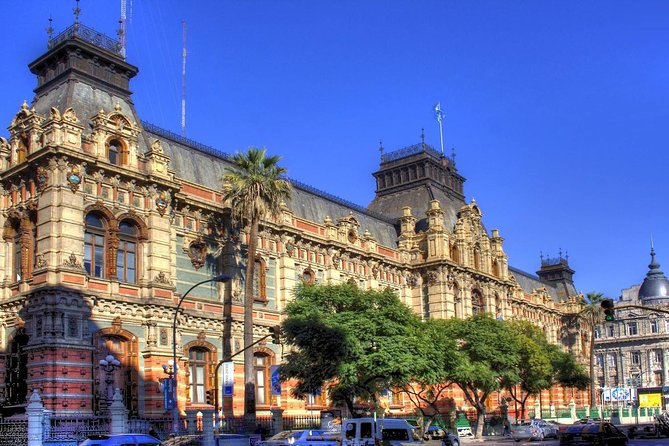
Palacio de Aguas Corrientes: Second French Empire flair meets city growth
Palacio de Aguas Corrientes was built to house water supply tanks as the city grew in the late nineteenth century. The wow factor is the pairing of a practical purpose with an exuberant exterior, using imported materials and the architect Olaf Boye (Norwegian, arriving in Buenos Aires in 1885). It also worked with local architects including Juan Antonio Buschiazzo, Adolfo Büttner, and Carlos Altgelt.
Look for the polychrome ceramic and the heavy façade ornamentation. It is a classic example of how upper-class Buenos Aires shaped the visual language of the city until around 1916.
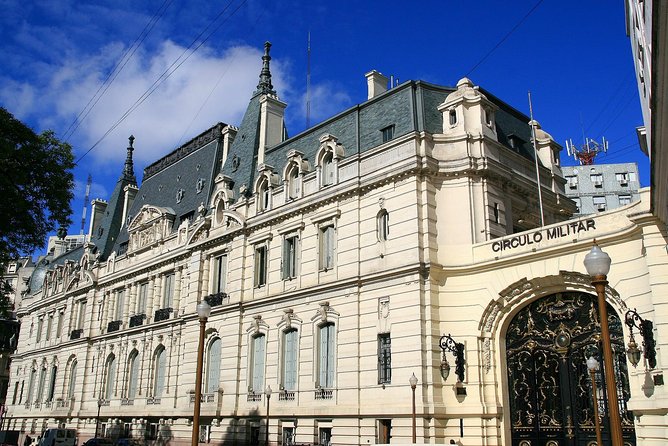
Palacio Paz: Beaux-Arts luxury made formal
Palacio Paz was owned by José C. Paz and reflects Beaux-Arts architecture from the early twentieth century. Since 1938, it has been the headquarters of the Military Circle.
The value here is less about a single trivia fact and more about learning how Buenos Aires handled power and prestige. The façade tells you the building was designed to impress.
Palacio San Martín: ceremonial Foreign Ministry across from Plaza San Martín
Palacio San Martín is the ceremonial seat of Argentina’s Foreign Ministry in the Retiro neighborhood, across from Plaza San Martín. It was designed for Mercedes Castellanos de Anchorena by architect Alejandro Christophersen in 1905 and inaugurated by the Anchorena family to commemorate the centenary of Argentine independence. It was called the Anchorena Palace until 1936, when it became the headquarters for the Foreign Ministry and took its current name.
If you want a quick way to understand how architecture changes jobs over time, this is it. You are seeing a former private aristocratic residence turned into a central government institution.
Embassy of France and Galería Güemes: style you notice even when you are rushing
Two stops here are perfect for people who enjoy street-level texture and design details.
Embassy of France: French academicism on full display
The building that houses the Embassy of France today was originally tied to Ortiz Basualdo-Zapiola. Built between 1912 and 1918, it is considered a strong example of French academicism, with a mix of styles that reflects artistic value.
This stop is especially helpful because it reminds you that Buenos Aires was not just copying one European trend. It blended, adapted, and mixed influences as it built.
Galería Guemes (Pasaje Güemes): art nouveau, reinforced concrete, and a true pedestrian shortcut
Galería Güemes, also called Pasaje Güemes, is an Art Nouveau style building with an interior pedestrian passage connecting Florida and San Martín. It has shops on two levels and is one of the earliest “modern” signals in the city.
Two standout points:
- It is described as the first building in Argentina built entirely of reinforced concrete
- Many consider it one of the country’s first skyscraper-style structures
It was inaugurated in 1915, and its name honors General Martín Miguel de Güemes, a hero of Argentina’s War of Independence.
If you only have time to walk one short section during the day, this is the one where the design reward is easy. You walk through it, you feel the scale, and the place gives you that Buenos Aires “how is this so charming” moment.
El Ateneo Grand Splendid: the bookstore that used to be a theater
El Ateneo Grand Splendid is a very specific kind of magic. This tour stop gives you the chance to visit a calm, book-filled interior that was once the National North Theater and later transformed. Before being a bookstore, it functioned as an immense avant-garde theater built in 1917.
The building sits on Santa Fe Avenue in the elegant Recoleta area. Look up and you will notice craftsmanship: a striking stained-glass window with book imagery and signage that highlights the theater-to-bookstore identity.
This stop is valuable for a simple reason. It shows Buenos Aires doing reuse well. You are not just consuming culture, you are seeing how a city gives a beloved space a new purpose without wiping away its character.
Who this tour suits best (and who may want a different pace)
This tour fits you if:
- You want a fast, guided orientation to several major architecture landmarks in one day
- You like architecture explained through symbolism, materials, and design choices
- You prefer a format with free pickup and drop-off
- You like short photo opportunities, not a marathon of indoor museum time
- You are traveling with kids, since the tour is described as kid-friendly
It might be less ideal if:
- You want long, in-depth museum-style visits at each stop
- You expect every stop to be an interior entry with included admission
- You are planning to treat Teatro Colón as a full visit and you have not budgeted for admission
How the guide style changes the day, and why it matters
One reason this tour scores high is that the guide does not just list names. In past experiences, guides like Alexandra have been described as friendly and able to tailor the half-day feel to real schedules. Others, including Julieta, Carolina, and Mariella, have delivered a clear walkthrough of architectural points while also adding context about Argentine culture and politics.
That is the difference between seeing buildings and understanding them. When the guide points out why a façade is designed a certain way, you start noticing similar choices across neighborhoods.
So if you book, do yourself a favor: ask one question at each stop. Something like, what should I look for on the façade, or what was this building trying to signal at the time? You will get more out of the 10-minute pacing.
Should you book this private architecture tour?
I think you should book this tour if you want a practical architecture overview that connects the city’s landmarks into one coherent story, with free pickup and a guide who keeps things fun and easy.
Skip it or adjust expectations if your main goal is long indoor time at every stop, or if Teatro Colón is your top priority and you have not planned for the ticket.
If you are the kind of traveler who enjoys spotting details, learning the why behind the look, and then using the rest of the day to wander more on your own, this is a solid choice for Buenos Aires.
Recently reviewed around Buenos Aires
- Meet Locals: Language Exchange Café in Buenos Aires★ 5.0 · 10 reviews
- Piazzolla Tango Show Only In Buenos Aires★ 4.5 · 10 reviews
- Madero Tango Show Including Executive Dinner In Buenos Aires★ 3.5 · 10 reviews
- Private City Tour & Transfer to the International Airport★ 5.0 · 10 reviews
- Esquina Homero Manzi Tango Show Ticket Including Optional Dinner in Buenos Aires★ 4.5 · 10 reviews
- VIP Dinner & Tango Show at El Viejo Almacen★ 4.5 · 10 reviews
- Premium service Buenos Aires city tour for small groups★ 4.0 · 11 reviews
- Buenos Aires City Tour★ 4.5 · 11 reviews
Private, compared.
Buenos Aires City Private Tour with Local Guide
Read our review →
Private Airport Transfer In or Out : Ezeiza (EZE) – Buenos Aires
Read our review →
Private Full-Day Iguazu Falls Tour with Airfare from Buenos Aires
Read our review →
Private City Tour with a friend in Buenos Aires
Read our review →
Private Tour: Buenos Aires and Delta del Tigre with Local Guide
Read our review →
Full Day Buenos Aires Private Walking Tour – Your Own Personal BA 101
Read our review →
Buenos Aires Private City Tour with Local Guide
Read our review →