
Reviewed · HISTORICAL TOURS
Private Evita and Peronism Historical Tour in Buenos Aires
This private Evita and Peronism tour is interesting because it turns Buenos Aires street corners into political and personal story beats, from the power center at Plaza de Mayo to the resting place in Recoleta. I love that it is led by an art historian, so the guide reads the city like a visual document, not just a lecture. I also like the city orientation angle, with a smart route that helps you understand where things are and why they matter, even if it is your first day in town.
One possible drawback: the stops are tightly timed, so you will not linger. Also, plan for entrance fees you might not expect, since the Casa Rosada visit and the Museo Evita ticket have specific payment rules.
Key takeaways before you go
- Art historian-led explanations that connect architecture, images, and ideology
- A first-time visitor friendly route from Plaza de Mayo to Recoleta
- Evita’s story told in stages with photos, videos, and documents at the museum
- Private format with hotel pickup and drop-off so your day stays easy
- Mix of paid and free entrances (Museo Evita and some Casa Rosada items require payment)
- A brisk 3-hour pace that is great for orientation, short for deep wandering
Why Evita and Peronism makes Buenos Aires click fast
Evita Perón is not a museum subject here. She is part of how Argentina talks about power, class, gender, and loyalty. This tour works because it keeps your feet moving through the places where those ideas got acted out, not only where they were written down.
You start in the political heart, then shift into the places tied to Perón and Evita’s lives, and finish with the kind of landmark Buenos Aires does best, a cemetery where memory becomes architecture. That structure helps you separate the bigger mythology from the concrete timeline.
And because it is private, you can ask real questions as you go, like why a building looks the way it does or why a moment mattered at the time.
More Historical Tours in Buenos Aires
- Historical Sherpa Food Tour of San Telmo with Street Food, Drinks
★ 5.0 · 920 reviews - Nazis in Buenos Aires: a historical walking tour
★ 4.9 · 193 reviews - San Telmo: Historical Guided Tour with Street Food & Drinks
★ 5.0 · 87 reviews
Casa Rosada and the Eva Perón Room at Plaza de Mayo
Casa Rosada is the starting point because it is where the executive power lives, right across from Plaza de Mayo in Monserrat. The building’s pink color is instantly memorable, and the location does the work of explaining why politics and public space are always linked in Buenos Aires.
Inside, the highlight is the Eva Perón Room, connected to Eva Perón’s work with the foundation that carries her name. You also see photographs showing major moments from her life, plus a cap she wore at the 1949 Youth Championships. That little object detail is exactly the kind of thing that makes history feel human instead of abstract.
One thing to plan for: Casa Rosada admission is not included, so you will want to be ready to purchase entry for the museum component on the day.
Luna Park Stadium and the 1944 meeting that shaped the story
Next you go to a place tied to the meeting between Colonel Juan Domingo Perón and Eva Duarte. The stop centers on Luna Park Stadium, where they first met at a charity festival on January 22, 1944.
Even though this is not a long stop, it is a useful pivot. It links the later “Evita” story to a real beginning, when their paths intersected through public events and social causes. It is also a reminder that Peronism is not only about speeches. It started in rooms and crowds, at the intersection of celebrity, politics, and charity.
If you like origin stories, this is the kind of stop that makes the rest of the tour feel more grounded.
Museo Evita: the museum that turns photos and documents into a timeline
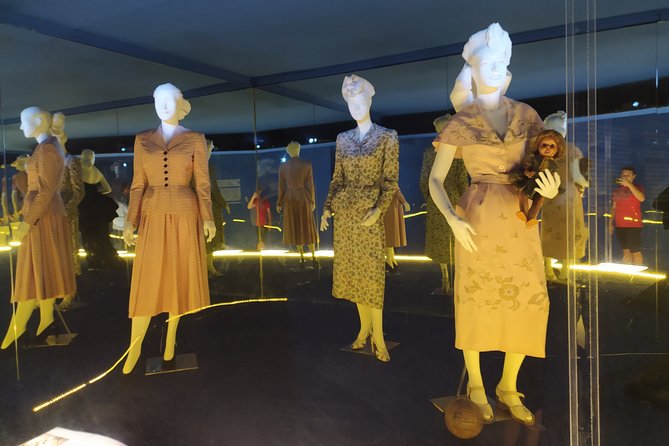
Museo Evita is the biggest story stop, and it is built to move you through her life in a sequence. You get about 30 minutes here, and the exhibition uses photographs, videos, and documents, so you are not stuck reading text panels the entire time.
The story is presented in stages. First you get the context of Argentina during her childhood and formative years, then you follow her path after she meets Perón, including how her social work grows once she is First Lady.
This is also where guides tend to shine, because a strong historian can point out what the images are doing. I like that the museum approach makes it easier to understand why Evita still polarizes opinion in Argentina, because you see both the message and the timing.
Important budget note: the Museo Evita ticket has a cost of $8.00 per person based on the tour price details. One practical tip is to bring that amount or be ready to pay on arrival so the day stays smooth.
Also, if you want a break inside the museum area, there is a restaurant option in this stop that can make your time feel more like a real outing than a sprint.
A different sort of day out of Buenos Aires:
- Local Foodie Adventure in Buenos Aires with Sherpa Food Tours
★ 5.0 · 6,875 reviews - Buenos Aires City Private Tour with Local Guide
★ 5.0 · 3,475 reviews - Buenos Aires Small-Group City Tour
★ 5.0 · 2,226 reviews - Buenos Aires Hop-On Hop-Off Bus, Free Walking Tours & Discounts
★ 4.5 · 2,218 reviews
Monument to Eva Perón: a quick stop with a big aftertaste
You will also see the Monument to Eva Perón, located in the plaza on Avenida del Libertador between Agüero and Austria, on the grounds of the National Library.
This stop is short, but it helps you understand how her image moved from private life into public symbols. Monuments are not just art. They are political statements made for decades of future passersby.
Think of it as a palate cleanser between the museum story and the deeper, quieter memory of Recoleta.
Facultad de Ingeniería: where the Eva Perón Foundation was based
The next move is to Facultad de Ingeniería, an unexpected but fascinating stop tied to the Eva Perón Foundation. In 1948, the foundation was created and the institution’s headquarters were set up in this building, where it operated for seven years.
Today, it belongs to the University of Buenos Aires and is recognized as a national historic monument. The building is Doric style, and the details here matter because they show how “modern power” and “institution building” looked in that era. You also get a sense of scale, since the building covers about 46,000 m2, has five floors and two basements, and can hold around 4,300 students.
This stop is included with free admission, so it is a good value moment in the route. It also gives you a wider angle on Peronism, because the foundation work was not only marches and headlines. It was organization and infrastructure.
Recoleta Cemetery: where Buenos Aires wealth turns into architecture
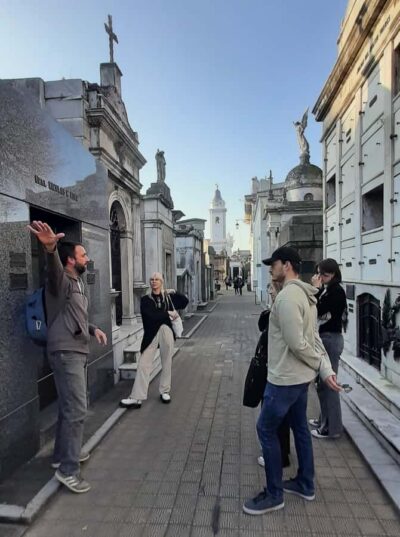
Recoleta Cemetery is one of Buenos Aires’s most famous landmarks, and it fits the Evita story because it is literally built from how the city remembers. The cemetery sits in the Recoleta neighborhood and was inaugurated on November 17, 1822.
You will see many imposing mausoleums and vaults with marbles and sculptures. It is architecture as status display, especially from the late nineteenth century, when Argentina was an emerging economic power and wealthy families started building spectacular pantheons nearby.
This is also a “slow your brain down” stop. You do not need to read every plaque to understand the vibe. Just looking at the design choices helps you grasp how public memory can become permanent and how power gets stored in stone.
Admission is free here, so you get a high-impact stop without an extra ticket decision.
Eva Perón’s tomb: an art deco vault and the story behind the repatriation
Not far from the Recoleta Cemetery entrance, the Duarte family vault holds María Eva Duarte de Perón’s remains. The tomb is about five meters underground in the second basement, and it is set in a space with an art deco style from the 1930s.
The vault door is bronze with flowers and leaves behind a Latin cross. Those details are worth pausing for, because they show how even a final resting place was designed as symbolism, not just storage.
There is also a repatriation story tied to the vault. The Duarte vault opened to receive Evita in 1974 when her remains were repatriated from Spain. Before that, her body was at the center of a confusing historical episode involving exile in the mid-fifties and burial in an Italian cemetery under a false name.
You get about 10 minutes for this part, free of charge. It is short, but it lands with weight, especially after the museum and the cemetery architecture you just saw.
Price and logistics: what $140 per person buys you
At $140 per person for about 3 hours, you are paying for three things that add up in Buenos Aires: a professional historian guide, a private format, and hotel pickup and drop-off.
If you are the kind of traveler who hates wasting half a morning figuring out transit and where to stand, the included pickup is a real value. You also get a guided logic to your walking and viewing time, which matters a lot for political and cultural landmarks. Buenos Aires can overwhelm you fast. This tour gives you a line to follow.
It is also worth knowing the day is not totally “all inclusive.” Entrance fees include: Museo Evita is $8.00 per person, Casa Rosada admission is not included, and tips are not included. The good news is Recoleta Cemetery and the Eva Perón tomb are free, and Facultad de Ingeniería is free too.
One practical point: the route is timed tightly. That is ideal if your goal is orientation and understanding. If your goal is deep museum time and lots of photos with long pauses, plan a follow-up visit on your own.
How the guide style affects your experience
This tour shines when the guide balances story with place-based detail. The guides have included art historian types, and you will see that in how they explain what you are looking at.
From past tours, names like Julieta and Rosa stand out, with praise for clear English and for being friendly, professional, and genuinely helpful. Guides such as Diego, Miguel, Leandro, Florencia, and Leo have also been mentioned for turning Evita and Peronism into an engaging morning, not a dry timeline.
For your part, ask your guide one simple question right at the start: how do they want to structure the story, life first or politics first. That helps a lot if you want a clean chronological primer.
Also, be aware that the Evita narrative can get emotional and polarizing, depending on what your guide chooses to emphasize. If you want a straightforward overview, tell them early so they can shape the pacing toward what you want.
Who should book this, and who should think twice
I think this is a great fit if you are:
- Visiting Buenos Aires for the first time and want smart orientation fast
- Interested in Evita but also in the wider meaning of Peronism in Argentina
- Traveling with a kid or teens who do well with short, story-based stops
It may not be the best fit if you:
- Want long, slow museum time at your own speed
- Prefer totally all-inclusive ticket pricing with no on-site payments
Should you book Private Evita and Peronism in Buenos Aires?
Yes, book it if you want your Buenos Aires morning to feel like real understanding, not just sightseeing. The combination of a historian guide, a route that strings together the political and personal threads, and included hotel pickup makes it a smooth way to get oriented and learn the story behind the symbols.
If you like to read everything slowly and linger, do this as your orientation tour, then plan a longer return day to the museum or cemetery that fits your pace.
FAQ
How much does the Private Evita and Peronism Historical Tour cost?
It costs $140.00 per person.
How long is the tour?
The tour lasts about 3 hours.
What time does the tour start?
The start time is 10:00 am.
Is the tour private?
Yes. It is a private tour, with only your group participating.
What is included in the price?
The tour includes a professional historian guide and hotel pick-up and drop-off.
Is the entrance fee for Museo Evita included?
No. The Museo Evita entrance fee is $8.00 per person.
Are Recoleta Cemetery and Eva Perón’s tomb free to enter?
Yes. Both have free admission.
Is Casa Rosada admission included?
No. Casa Rosada admission ticket is not included.
Is the tour kid-friendly?
Yes, the tour is kid-friendly.
Can I cancel for free?
Yes. Free cancellation is available if you cancel up to 24 hours in advance of the experience start time.
Recently reviewed around Buenos Aires
- Meet Locals: Language Exchange Café in Buenos Aires★ 5.0 · 10 reviews
- Madero Tango Show Including Executive Dinner In Buenos Aires★ 3.5 · 10 reviews
- Piazzolla Tango Show Only In Buenos Aires★ 4.5 · 10 reviews
- Esquina Homero Manzi Tango Show Ticket Including Optional Dinner in Buenos Aires★ 4.5 · 10 reviews
- Private City Tour & Transfer to the International Airport★ 5.0 · 10 reviews
- VIP Dinner & Tango Show at El Viejo Almacen★ 4.5 · 10 reviews
- Buenos Aires City Tour★ 4.5 · 11 reviews
- Premium service Buenos Aires city tour for small groups★ 4.0 · 11 reviews
Historical Tours, compared.
Historical Sherpa Food Tour of San Telmo with Street Food, Drinks
Read our review →
Nazis in Buenos Aires: a historical walking tour
Read our review →
San Telmo: Historical Guided Tour with Street Food & Drinks
Read our review →
Recoleta Cemetery – Small Group Tour of History & Secrets
Read our review →
Browse the lists this tour appears in